Real-World Evidence
Real-world evidence (RWE) is reshaping how health technology assessment (HTA) bodies and payers evaluate health technologies. As regulatory agencies increasingly accept observational data alongside — and sometimes in place of — randomised controlled trials, the ability to generate credible RWE has become a critical capability for life science companies.
Yet the quality of published observational research remains strikingly uneven. Studies are routinely designed without pre-specified protocols, conducted without adequate control for confounding, analysed without appropriate statistical methods and reported without adherence to established guidelines. The result is an evidence base that collapses under HTA scrutiny at precisely the moment it is needed most. Closing this quality gap requires methodological discipline that most clinical teams and many research organisations do not currently possess.
This course provides a practical, end-to-end framework for designing, conducting, analysing and appraising observational studies to assure they meet the evidentiary standards of HTA bodies and payers. Over eight modules participants move from understanding data sources and study designs through protocol development, bias identification, statistical methods for causal inference and reporting standards — with a consistent emphasis on what distinguishes trusted RWE from untrusted RWE.
Delivered via IHLM’s online learning platform and through live interactive Zoom webinars, this course will help you become part of a global community producing credible RWE that shapes market access.
On completion of this course you will be able to:
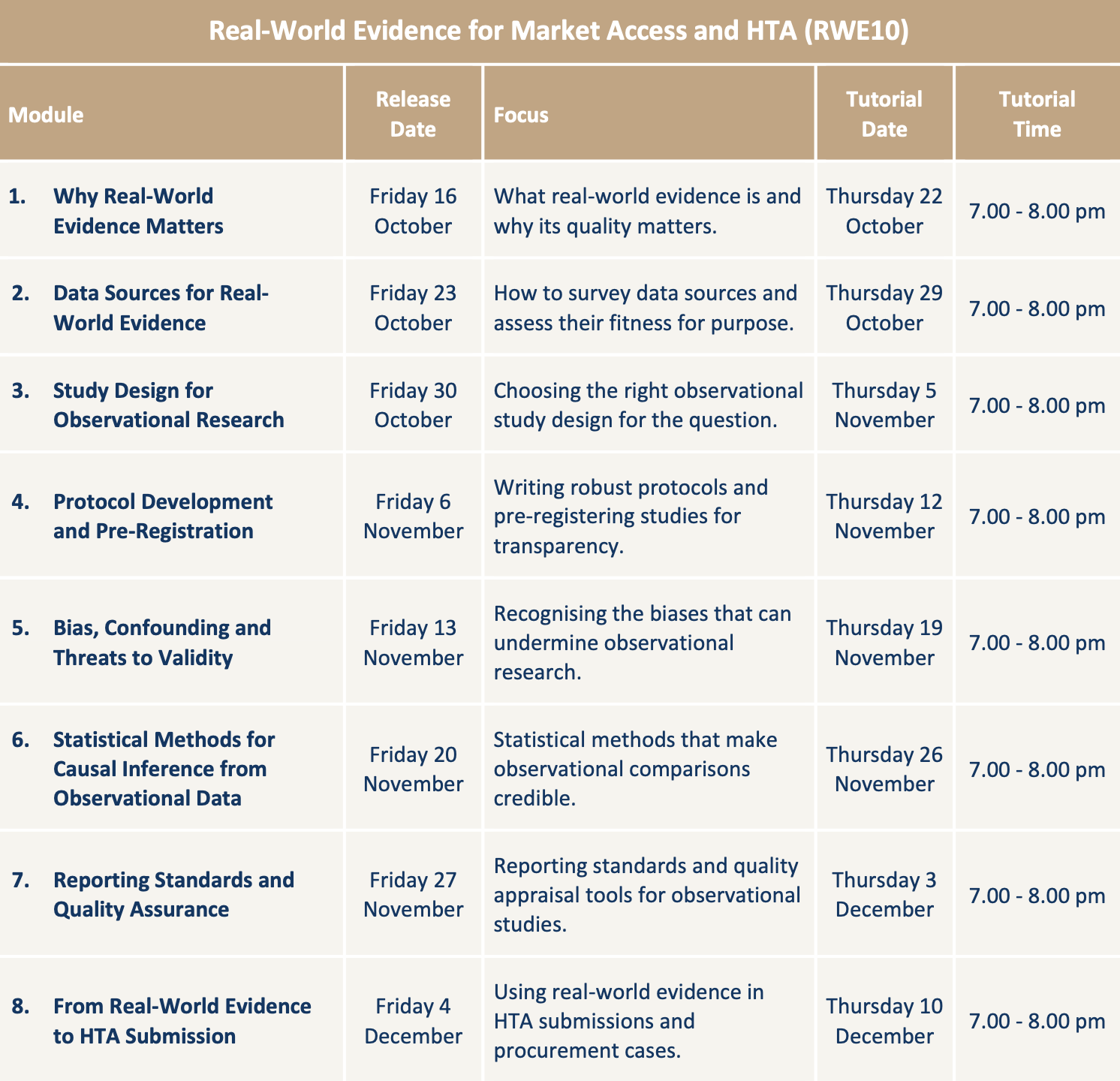
This course is broken down into eight manageable weekly modules:
This course should take approximately 6 – 8 hours per week. You can expect to devote about 2 – 3 hours per week to self-paced learning, about 2 hours per week preparing for and participating in the virtual tutorial and 2 – 3 hours per week applying your knowledge through learning activities and mini-projects. Every tutorial is recorded so you can rewatch it at any time.
This course is designed for market access professionals, medical affairs specialists, HEOR managers and clinical researchers in the life sciences industry who commission, conduct or appraise real-world evidence studies. It is equally relevant for clinicians and academic researchers undertaking observational research and for regulatory affairs professionals navigating the growing role of RWE in regulatory and HTA decision-making. No prior statistical training is required, though participants will benefit from familiarity with clinical research concepts and basic study design terminology.
Upon successful completion of the course you’ll receive an:
Ready to start? Just click the ‘Register now’ button at the top of this page or use the ‘Ask us a question’ button if you’d like to talk to one of our course facilitators. The fee for this course is £995 per person. If you’d like to pay in instalments you can arrange this by contacting us at: registration@ihlm.org.
All registrations are subject to our terms and conditions which are available here. By registering for an IHLM course you are accepting these terms and conditions and agreeing to be bound by them.
Randomised controlled trials are not always feasible, affordable or appropriate. Real-world evidence (RWE) has become an increasingly accepted component of health technology assessment (HTA) — but only when the underlying studies are designed to a standard that payers will trust. This module introduces the RWE landscape and explains why generating credible observational evidence requires a structured methodology.
The quality of any RWE study is constrained by the data it draws on. This module surveys the main data sources available for such research and covers how to assess whether a data source is fit for the research question at hand.
The choice of study design determines the strength of causal inference an observational study can support. This module covers the main observational designs and provides a framework for selecting the right design based on the research question and available data.
An observational study without a pre-specified protocol is an invitation to data dredging — and HTA bodies know it. This module covers how to write a robust study protocol for observational research, drawing on the HARPER template and international best practice.
Every observational study is vulnerable to biases that randomisation would have eliminated. This module covers the threats to validity that arise most frequently in RWE research and explains why ignoring them produces results that payers will not believe.
When randomisation is absent, statistical methods must make treatment groups comparable. This module covers the core analytical techniques at a level that enables participants to commission, conduct or critically appraise analyses of RWE.
An observational study is only as credible as its reporting is transparent. This module covers the reporting frameworks and quality appraisal tools that journals and HTA bodies use to evaluate RWE — and how to build compliance in from the outset.
Generating credible real-world evidence is only valuable if it reaches the right decision-makers in the right format. This final module covers how RWE findings are used within HTA submissions, value dossiers and procurement cases.



Patient Experience

A comprehensive course for progressive healthcare providers and professionals who want to design and deliver more person-centred, compassionate and responsive care.
Healthcare Leadership

Our flagship course for high-potential healthcare leaders: built around the core strategic management disciplines and designed to prepare you for more senior roles and greater responsibilities.
HEOR Strategy

This course enables you to plan, design and manage the clinical and economic evidence needed to support market access, reimbursement and health technology assessment.
Health Economic Modelling

A practical, Excel-based course on how to design, build and present budget impact models for health technology assessments, business cases and value propositions.
Health Economic Modelling

This hands-on course shows you how to build, interpret and present cost-effectiveness and cost-utility models that measure the value of health interventions and guide healthcare decision-making.
Evidence Review and Synthesis

Discover how to plan, commission and evaluate rapid evidence reviews that generate accelerated, evidence-based insights in response to time-sensitive demands.
Real-World Evidence

A practical course that equips you to design, conduct, analyse and appraise observational studies that generate credible evidence for HTA bodies and payers.
Evidence Review and Synthesis

A practical course that will enable you to compile, appraise and summarise existing research using the “gold standard” in evidence-based decision-making.
HEOR Strategy

Discover how artificial intelligence is reshaping health economics and outcomes research — and what it means for the professionals who commission and undertake this work.
Quality and Safety

Discover how to set up effective error reporting systems, lead investigations into adverse incidents, implement successful patient safety improvement projects and design safer systems of care.
Quality and Safety

This course will enable you to master the concepts, methods and tools you need to lead successful quality improvement projects or become a quality improvement specialist.
Productivity and Value

This course will enable you and your healthcare organisation to achieve operational excellence by improving capacity, productivity and patient flow at every stage of care.
Productivity and Value

This course will enable you to accelerate your hospital’s post-pandemic recovery and implement proven strategies for transforming performance in the operating room.
Healthcare Leadership

Aimed at first time healthcare leaders and those aspiring to their first leadership role, this programme will enable you to improve teamwork and take responsibility for people and services.
Productivity and Value

This course gives you practical tools for making better financial decisions and maximising the financial performance of your healthcare organisation.
February 13, 2026
Introducing yourself properly is surely a basic necessity if we’re to be a respectful and trusted caregiver?
May 9, 2025
Can glove change help reduce the costs and improve the outcomes of caesarean sections – enabling obstetric teams to deliver more value-based care?
Course starts: 05 March 2026
Location: Online
Course starts: 05 March 2026
Location: Online

