HEOR Strategy
AI is no longer just a future possibility for health economics and outcomes research (HEOR) — it is already changing how evidence is synthesised, how economic models are built and how real-world evidence is analysed. Tools that were experimental two years ago are now embedded in the workflows of leading consultancies, contract research orgasnisations (CROs) and life science companies. Yet adoption remains uneven, and the gap between organisations that are using AI effectively and those that are still watching from the sidelines is widening. For professionals who commission, oversee, undertake or evaluate HEOR work, understanding what these tools can and cannot do is now a core competency — not a technical curiosity.
This course provides a structured, critical introduction to AI across the major HEOR disciplines. Over six modules, participants move from the current landscape through evidence synthesis, health economic modelling, real-world evidence and governance — with a consistent emphasis on practical application, validation and the limitations that matter when AI-assisted outputs feed into health technology assessments (HTAs) and reimbursement decisions. The course will be refreshed annually as the technology and regulatory environment evolves, ensuring that participants are learning what is, rather than what was current.
Delivered via IHLM’s online learning platform and through live interactive virtual tutorials this course will enable you to harness the possibility of AI in your own HEOR or market access practice.
On completion of this course you’ll be able to:
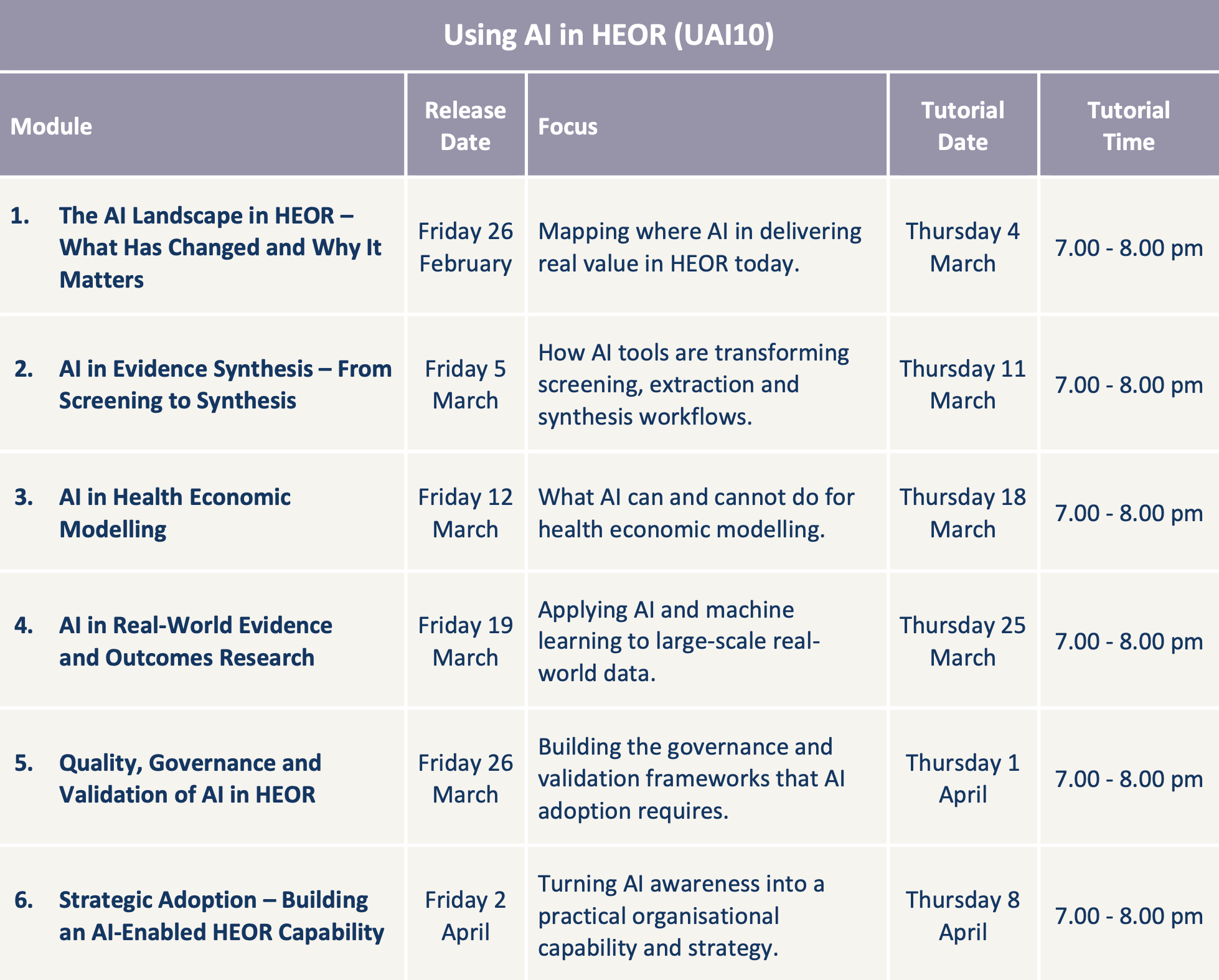
This course is broken down into six manageable weekly modules:
This course should take approximately 6 – 8 hours per week. You can expect to devote about 2 – 3 hours per week to self-paced learning, about 2 hours per week preparing for and participating in the virtual tutorial and 2 – 3 hours per week applying your knowledge through learning activities and mini-projects. Every tutorial is recorded so you can rewatch it at any time.
This course is designed for market access, medical affairs and HEOR professionals in life science companies, consultancies and CROs who need to understand how AI is changing the way HEOR work is planned, commissioned and delivered. It is equally relevant for regulatory affairs professionals evaluating AI-assisted submissions and for HTA or procurement professionals encountering AI-generated evidence with increasing frequency. No technical background in AI, machine learning or programming is required — the course is built around practical application and critical appraisal rather than technical implementation.
Upon successful completion of the course you’ll receive an:
Ready to start? Just click the ‘Register now’ button at the top of this page or use the ‘Ask us a question’ button if you’d like to talk to one of our course facilitators. The fee for this course is £745 per person. If you’d like to pay in instalments you can arrange this by contacting us at: registration@heorinstitute.com.
All registrations are subject to our terms and conditions which are available here. By registering for an IHLM course you are accepting these terms and conditions and agreeing to be bound by them.
Artificial intelligence has moved from theoretical prospect to working reality across multiple health economics and outcomes research (HEOR) disciplines. This module maps the current landscape — where AI tools are genuinely useful today, where they are promising but immature and where the claims outrun the evidence.
Evidence synthesis is where AI is most mature, most practically useful and most likely to change how work is commissioned and delivered. This module goes deeper than any other in the course, covering the specific tools, workflows and validation approaches already reshaping how reviews are conducted.
Health economic models have historically been built by hand in spreadsheets — a process that is time-consuming, error-prone and difficult to audit. This module examines how AI is beginning to change the modelling workflow while being candid about the current limitations.
Real-world evidence generation involves large, messy datasets and complex analytical decisions. AI and machine learning methods are increasingly applied to tasks that were previously impractical — but their adoption in HTA-grade research requires careful attention to transparency and reproducibility.
Adopting AI without governance is a risk. This module addresses the quality assurance, ethical and regulatory considerations that organisations must navigate when integrating AI into HEOR workflows.
Understanding what AI can do is the starting point. This final module addresses how to adopt AI tools strategically — without overcommitting to tools that may not last or underinvesting in capabilities already delivering returns.



Patient Experience

A comprehensive course for progressive healthcare providers and professionals who want to design and deliver more person-centred, compassionate and responsive care.
Value Communication

Discover how to set up effective error reporting systems, lead investigations into adverse incidents, implement successful patient safety improvement projects and design safer systems of care.
Healthcare Leadership

Our flagship course for high-potential healthcare leaders: built around the core strategic management disciplines and designed to prepare you for more senior roles and greater responsibilities.
Value Communication

This course will enable you to master the concepts, methods and tools you need to lead successful quality improvement projects or become a quality improvement specialist.
Health Economic Modelling

A practical, Excel-based course on how to design, build and present budget impact models for health technology assessments, business cases and value propositions.
Health Economic Modelling

This hands-on course shows you how to build, interpret and present cost-effectiveness and cost-utility models that measure the value of health interventions and guide healthcare decision-making.
Evidence Review and Synthesis

Discover how to plan, commission and evaluate rapid evidence reviews that generate accelerated, evidence-based insights in response to time-sensitive demands.
Real-World Evidence

A practical course that equips you to design, conduct, analyse and appraise observational studies that generate credible evidence for HTA bodies and payers.
Evidence Review and Synthesis

A practical course that will enable you to compile, appraise and summarise existing research using the “gold standard” in evidence-based decision-making.
HEOR Strategy

Discover how artificial intelligence is reshaping health economics and outcomes research — and what it means for the professionals who commission and undertake this work.
Value Communication

Discover how to transform clinical, economic and outcomes evidence into a compelling value story that convinces decision-makers and accelerates market access.
Health Technology Assessment

This case study-based course introduces you to the fundamentals of health technology assessment and how to get submissions right first time.
HEOR Strategy

This course enables you to plan, design and manage the clinical and economic evidence needed to support market access, reimbursement and health technology assessment.
Health Technology Assessment

This course will enable you and your healthcare organisation to achieve operational excellence by improving capacity, productivity and patient flow at every stage of care.
February 13, 2026
Introducing yourself properly is surely a basic necessity if we’re to be a respectful and trusted caregiver?
May 9, 2025
Can glove change help reduce the costs and improve the outcomes of caesarean sections – enabling obstetric teams to deliver more value-based care?
Course starts: 01 May 2026
Location: Online
Course starts: 26 June 2026
Location: Online

